
NYSAC Pushes State to Address Early Intervention Funding Needs
By Joe Mahoney, NYSAC Contributor
Experts in childhood development have long touted the lasting benefits of providing services to babies and toddlers experiencing delays in communication, cognitive development and other areas.
Now, a study published in the Journal of the American Medical Association is being cited by leaders of New York county health departments to show that those services are well worth the public investment in Early Intervention programs.
The study used comprehensive data for more than 214,000 New York City children, including 13,022 who received Early Intervention services. It found that receiving Early Intervention services before age 3 was an important factor in achieving higher English language arts and math scores on tests administered to third-graders.
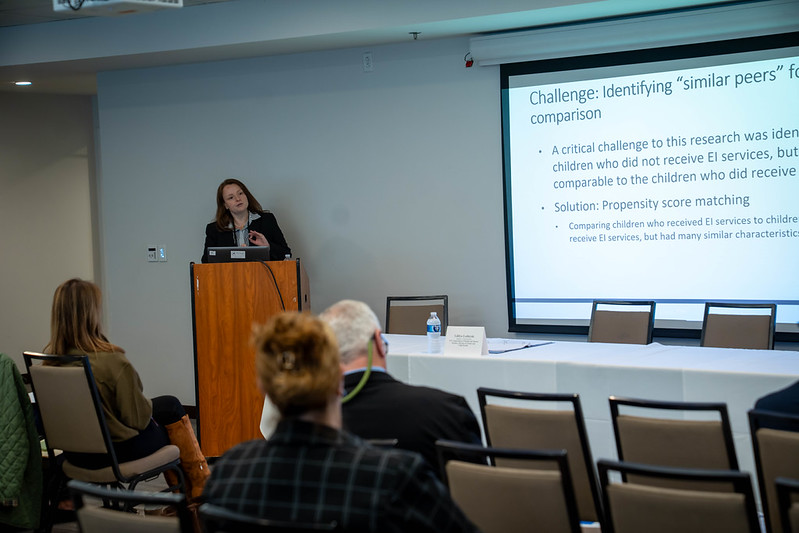
"Our data proves that early intervention works for children and families," said Lidiya Lednyak, deputy commissioner of the New York City Department of Health and Mental Hygiene and one of the co-authors of the study. She added: "But that success is entirely dependent on having an appropriately funded system in which counties are reimbursed in a timely and fair fashion, and on having therapists available to walk through a family's front door."
Lednyak, speaking at a workshop during the 2026 New York State Association of Counties Fall Seminar in Syracuse, outlined how early investments in children and families improve outcomes for future generations.
"Why is the investment worth it?" Lednyak asked. "Simply put, the window between birth and three represents a biological opportunity that will never again happen in a human life. I am not exaggerating by making the statement that right from birth to age 3, more than one million new neural connections are formed every second, and a neural connection is that thing in the mind that creates the foundation for future learning, health and behavior."
Another benefit of Early Intervention programs is that many children who receive the services do not need special education services upon entering preschool.
"Longitudinal studies demonstrate there's an $8 return for every dollar invested in early childhood services," Lednyak said.
NYSAC and an affiliated organization, the New York State Association of County Health Officials, are urging that New York municipalities receive a fair share of the Early Intervention Covered Lives Assessment. They point out that the Covered Lives Assessment is designed to offset chronic underpayment by commercial insurers. Since 2022, they say, counties have received only $15 million of the expected $20 million, even though $40 million was appropriated in the state budget.
Meanwhile, counties have been experiencing difficulties keeping up with provider payments because the state has no regular disbursement schedule for issuing Covered Lives payments.
"At this time, the New York State Early Intervention program is facing significant challenges, including workforce shortages, significant increased workload from administrative burden placed on counties, EI reimbursements that are owed to counties by New York State, and this is all happening in an environment where resources are strained and program structures are being questioned," Lednyak said.
In New York, Early Intervention programs are administered by county governments and New York City, a responsibility assigned to them by New York State Public Health Law. Across the state, approximately 70,000 children are served by Early Intervention programs.
The services are completely free to families. Eligibility requires that a baby or toddler have a confirmed disability or be experiencing developmental delays in physical, cognitive, communication, social-emotional or adaptive development. Services provided include assistive technology, speech pathology, and physical and occupational therapy.
NYSAC is tackling the funding issues head-on. One of the NYSAC resolutions adopted at the Fall Seminar calls on the state Division of the Budget to expedite the release of retroactive Medicaid funds to counties and municipalities that have been shortchanged on their fair share of Early Intervention funding.
The resolution also calls on the state Department of Health, the Bureau of Early Intervention and the Office of Health Insurance Programs to resume their regular flagging of claims and biannual payment of retroactive Medicaid claims to counties. Further, NYSAC is asking its member counties to adopt similar resolutions.
The funding issues have also created challenges for counties in recruiting and retaining providers of early childhood services.
"Investments are needed to grow the early intervention workforce so that we can continue to serve these kids," Lednyak said.
She said there is also a need to modify licensing and credentialing requirements to make it easier for counties to recruit therapists and other providers.
Another NYSAC resolution calls on the governor and the state Legislature to invest in the Early Intervention workforce by providing incentives for academic programs that will result in more Early Intervention specialists entering the field.
Lednyak said she hopes the new data documenting the long-term benefits of Early Intervention will help draw greater attention to the program's funding and workforce challenges. For counties tasked with administering these services, the findings reinforce the importance of ensuring that children and families can access the support they need during their earliest years.